
News Room
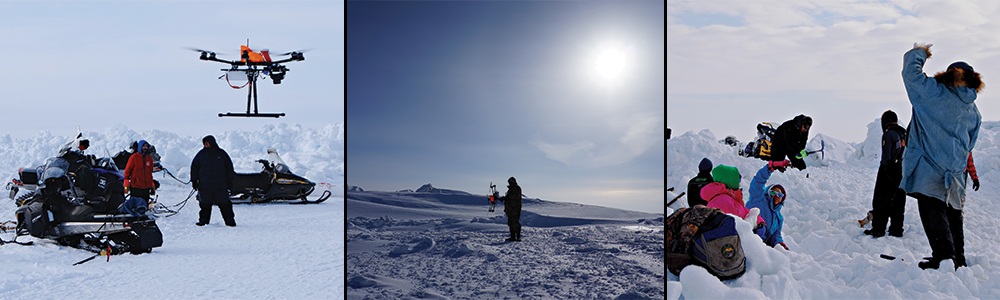
Unmanned aircraft scouts ice conditions for whalers
Before spring whaling can even start up on the North Slope, crews and other community members chip away at the sea ice to make miles-long trails to open water, and hopefully, to whales. The process is done with hand tools — mostly ice picks — taking days or weeks, and is very labor intensive. So when researchers at the University of Alaska Fairbanks offered to fly a small, unmanned aircraft over the ice in hopes of finding the safest, most efficient routes to open leads, whaling captains in Barrow were all for it.
Researchers study sea otters with unmanned aircraft
Watching marine life to gather data about behavior and abundance can be tedious and time-consuming for researchers, but recent studies indicate unmanned aircraft may offer a way around such obstacles.
Drone Researchers Find a New Frontier in Alaska, the Arctic
Alaska has been called America's last frontier -- but now the state's wild reaches are providing a key testing ground for researchers and native-owned companies exploring ways to use drones in their work.
UAF unmanned aircraft group part of FAA Center of Excellence
The University of Alaska Fairbanks is part of the team selected by the Federal Aviation Administration as a new National Center of Excellence for Unmanned Aircraft Systems.
Alaska’s Unmanned Aircraft Systems Legislative Task Force on UAS
The Unmanned Aircraft Systems Legislative Task Force encourages prospective drone operators to review the following important safety sheet to know where you are authorized to fly, for what purposes, and other safety guidelines. This sheet is also for drone vendors, drone purchasers, drone owners, and others to make available to those who may or will be flying UAS/drones.
FAA Streamlines COAs for the Six UAS Test Sites
The Federal Aviation Administration has made it simpler for the six unmanned aircraft systems (UAS) test sites to conduct research by giving them “blanket” authorizations to fly public aircraft operations throughout the National Airspace System at or below 200 feet.
FAA Streamlines COAS for the Sec 333’s
The Federal Aviation Administration has established an interim policy to speed up airspace authorizations for certain commercial unmanned aircraft (UAS) operators who obtain Section 333 exemptions. The new policy helps bridge the gap between the past process, which evaluated every UAS operation individually, and future operations after we publish a final version of the proposed small UAS rule.